

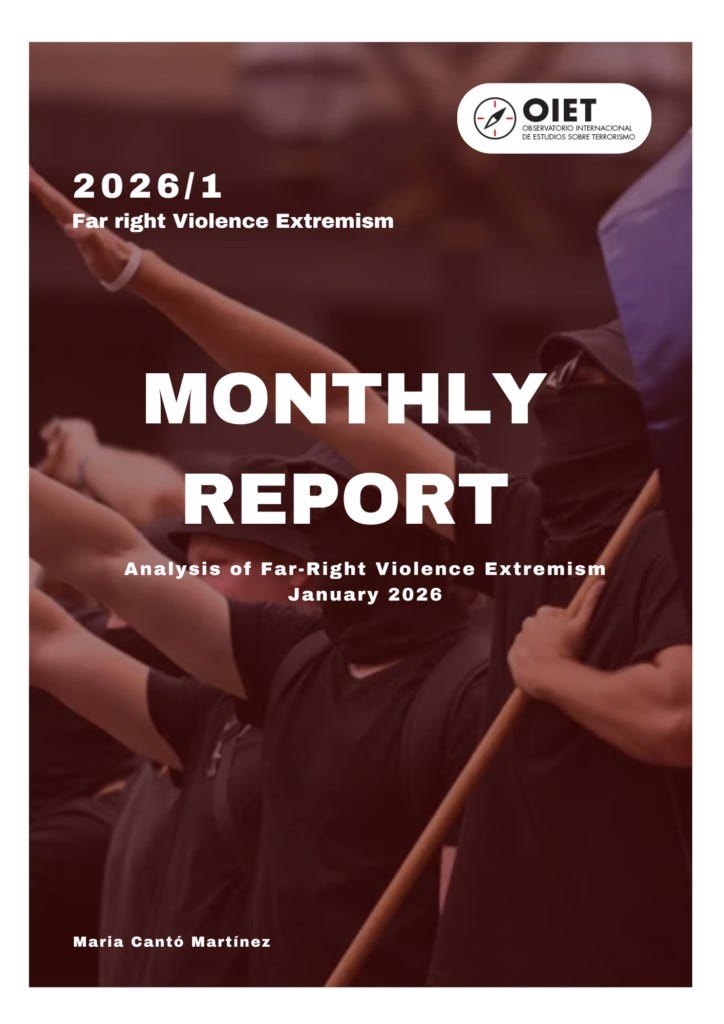
The Observatorio Internacional de Estudios sobre Terrorismo (OIET), a Spain-based research institute specializing in the study of terrorism and radicalisation, warns in its January 2026 analysis that far-right violence remains a persistent threat in Europe and North America. The independent research center publishes regular reports tracking extremist incidents, ideological trends and emerging security risks.
According to its latest assessment, far-right extremism continues to be one of the most dynamic forms of violent radicalism. The report highlights both concrete acts of violence and a broader wave of online radicalisation. Digital platforms, the institute notes, play a central role as spaces where conspiracy theories, racist ideologies and calls for violence circulate and become normalized.
A significant portion of recent threats involve so-called “lone actors”, individuals who may not formally belong to an organisation but draw ideological inspiration from transnational extremist networks and online communities. Because these actors operate outside traditional hierarchical structures, they are often harder for authorities to detect in advance.
The institute also emphasizes that far-right violence increasingly intersects with wider social tensions, including debates over migration, identity politics and distrust of public institutions. In several countries, researchers observe a normalization of radical rhetoric in mainstream discourse, which they warn can create an environment in which violence becomes more easily justified.
While the number of large-scale attacks fluctuates from month to month, the report concludes that the underlying radicalisation dynamics remain stable. The institute calls for sustained monitoring, strengthened prevention strategies and enhanced international cooperation to better track cross-border extremist networks.
Overall, the analysis suggests that far-right violence is not an isolated phenomenon but part of a broader, digitally amplified ideological movement that adapts flexibly to national contexts, requiring an equally coordinated and adaptable policy response.
Source:
Analysis of Far-Right Violence Extremism – January 2026 | Observatorio