

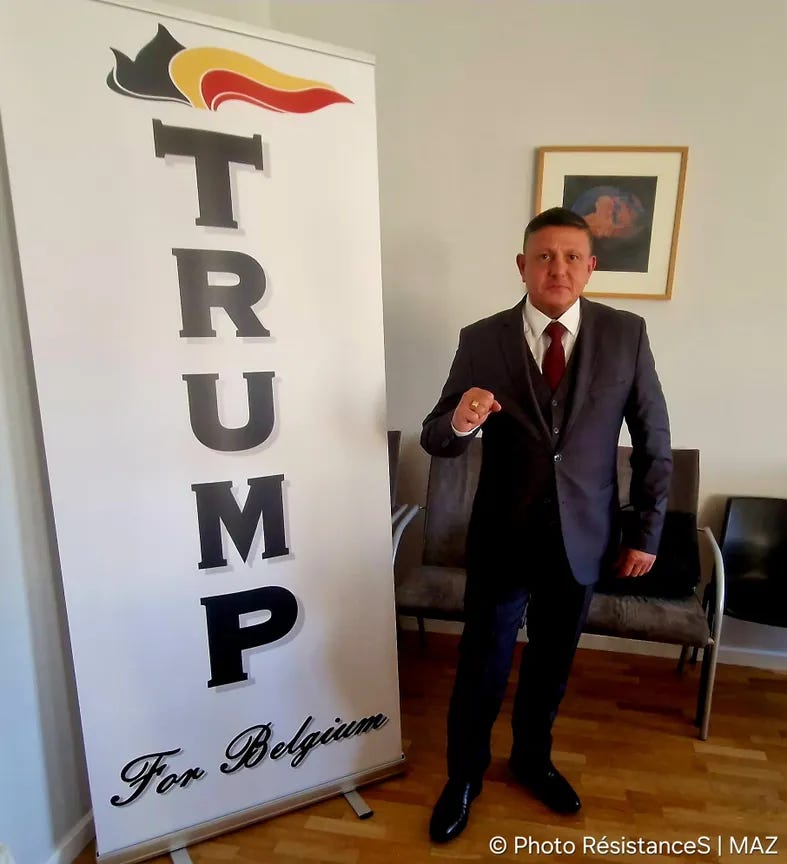
On November 7, 2025, a new political party was launched in Belgium under the name ‘Trump’, short for Tous Réunis pour l’Union des Mouvements Populistes (“All United for the Union of Populist Movements”). It’s not satire. It’s the latest rebranding of the country’s far-right landscape, picking up where the dissolved party Chez Nous left off, itself a reincarnation of the old Belgian Front National.
The founder and chairman, Salvatore Nicotra, is a long-time figure in the Belgian far right, formerly leading both Front National and Agir. One of his key allies is Emanuele Licari, briefly associated with Vlaams Belang in Brussels until he was sidelined for openly praising fascism. He’s now back in the picture, handling Brussels strategy and international populist outreach.
The name ‘Trump’ is deliberate. “Donald Trump is the symbol of populism,” says Nicotra. That symbolic alignment signals the party’s ideological lineage rooted in nationalism, anti-elitism and the strategic use of cultural resentment. It also marks a shift: an attempt to unify fragments of far-right energy under one brand, now openly international in tone.
Ideologically, the party claims to combine “40% Marxist-left PTB, 40% Flemish far-right Vlaams Belang, and 20% original ideas.” It’s a hybrid of social populism and identitarian nationalism, framed as a unitarist alternative to Vlaams Belang’s separatism, a clear play to appeal to disaffected voters in French-speaking Belgium.
Trump plans to contest federal and European elections in 2029, with a focus on Wallonia, especially Hainaut Province, a traditional stronghold of economic discontent and right-wing protest votes. Brussels is also on the map, including both the regional parliament and municipal councils like Brussels City and Saint-Gilles. An eventual move into Flanders is not ruled out.
This isn’t fringe noise, it’s a sign of the times. The fusion of economic populism with authoritarian nostalgia is becoming increasingly adaptable, increasingly palatable. Trump, in this context, isn’t just a name. It’s a signal that the populist playbook is alive and expanding, and that far-right politics is once again being normalized under new banners with familiar ambitions.
The question, as always, is not whether this movement will win tomorrow. It’s whether anyone will stop pretending it’s still unthinkable.
Source:
Bram Van Renterghem, Trump is nieuwe extreemrechtse partij: ‘Ons programma is deels PTB, deels Vlaams Belang’, Bruzz, 10/11/2025