

Public diplomacy was once meant to build bridges. Under Donald Trump, it has become a weapon.
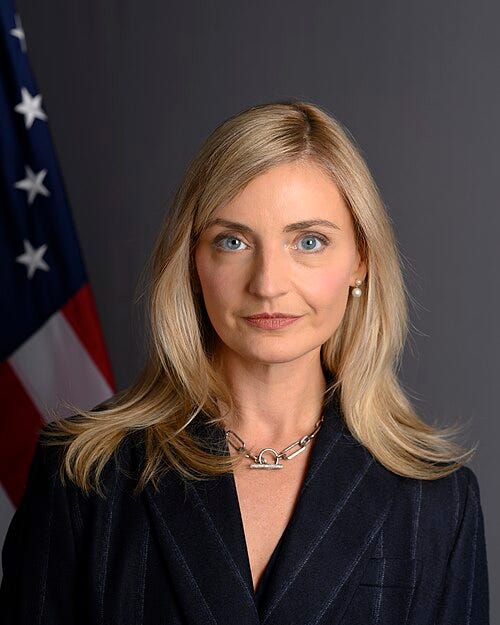
Sarah B Rogers, the undersecretary of state for public diplomacy, has positioned herself openly alongside Europe’s far-right opposition. Not discreetly, not diplomatically, but visibly, through meetings, social media interventions and sanctions.
In Germany, Rogers sought contact with the Alternative für Deutschland (AfD), a party designated by Germany’s domestic intelligence service as right-wing extremist. She met with Markus Frohnmaier, the party’s foreign policy spokesman.
When Berlin formally labeled the AfD a threat to the democratic order, Washington reacted with outrage. Marco Rubio called the move “tyranny in disguise.”
The message was unmistakable: restricting the far right is, in this view, restricting freedom.
Rogers has also attacked European hate speech laws and defended expressions that would be criminal in parts of Europe but are protected in the United States. She has cited Brandenburg v. Ohio to underscore that inflammatory speech is often shielded under the First Amendment unless it directly incites imminent violence.
The legal divergence is real. European democracies, shaped by their twentieth-century history, accept broader limits on hate speech. The United States takes a far more absolutist approach.
What is new is the strategic use of that divergence. Washington is no longer treating the difference as cultural variation but as moral hierarchy. European regulation is framed not merely as different, but as suspect.
The confrontation extends into the digital sphere. European measures such as the Digital Services Act are portrayed in Washington as attempts to censor American viewpoints. At the urging of figures including Eric Schmitt, visa sanctions were announced against individuals involved in countering online disinformation, among them Imran Ahmed of the Centre for Countering Digital Hate.
A federal judge temporarily blocked Ahmed’s deportation. But the signal had already been sent: Europe’s regulatory ambitions could carry diplomatic costs.
What is taking shape is not traditional statecraft, with treaties and troop deployments, but symbolic alignment and ideological reinforcement. The office once designed to make America attractive abroad is now used to cast doubt on European democratic choices.
This is not neutral diplomacy. It is political positioning.
Washington has chosen a side in favour for Europe’s far right.
Source: